
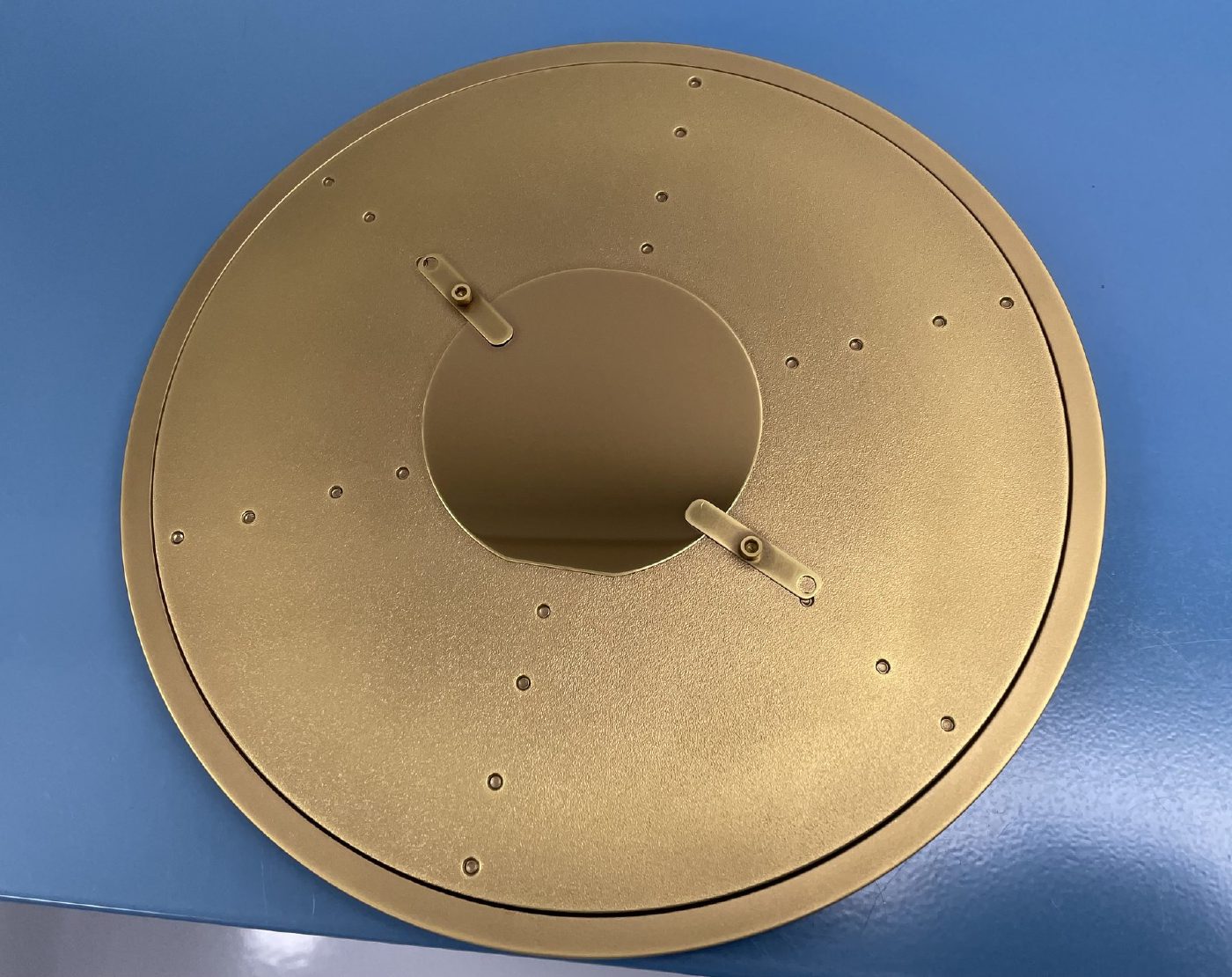
Any device that passes current into a liquid has the same problem: electronics carry current as electrons; tissue, blood and test samples carry it as ions. Somewhere there has to be a surface where one hands off to the other. This turns out to be harder than it sounds. Perhaps the most familiar manifestation is the “goop” (conductive gel) squeezed onto defibrillator paddles before a shock.
For electrodes the surface is usually a thin film, from a few hundred nanometres to a few microns thick, and it decides most of what matters: how much charge can cross, how fast, how much signal is lost as noise, and what chemistry happens as a side effect. The same short list of films appears in pacemaker leads, cochlear implants, brain and nerve stimulators, recording arrays, and electrochemical sensors.
This note is a primer on that list. It covers what the films are, how they work, where each one fails, and how to choose. It is opinionated where we believe the evidence supports an opinion.
Why the coating matters
Clinical stimulators with large electrodes run at modest charge densities. Cochlear implants normally stay under about 20 µC/cm² per pulse, and a commonly cited limit for brain stimulation is 30 µC/cm². Bare platinum can supply that safely, which is why platinum has done the job for decades.
The pressure comes from miniaturization. Shrink an electrode a hundredfold to address single cells, or to fit hundreds of sites on a probe, and the charge per pulse does not shrink with it. Charge density climbs past what a smooth metal can deliver without driving reactions that damage the electrode or the tissue (recall that water starts to split at a little over a volt). On the recording side, a smaller site means higher impedance and more noise.
A coating fixes both by giving the electrode far more working surface, or a more capable surface, than its footprint suggests.
Three ways to move charge
The most useful way to sort electrode materials is by what happens at the surface when charge crosses. There are three cases, and most confusion in this field comes from comparing them on a single number.
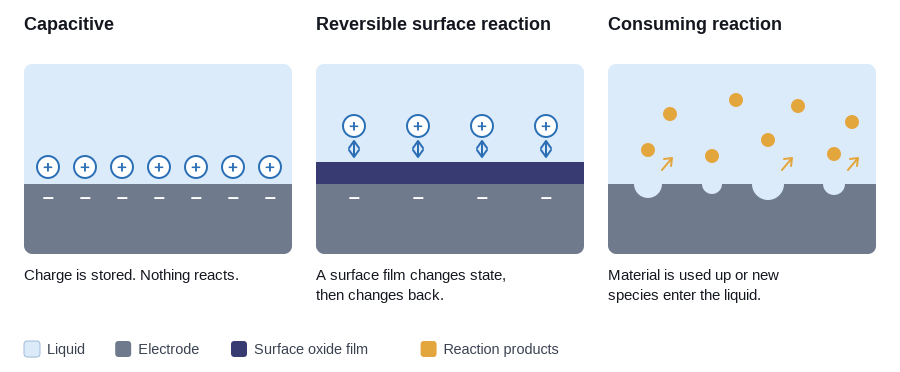
Capacitive. Electrons gather on the metal side and ions line up on the liquid side, a fraction of a nanometre apart. Nothing reacts and nothing crosses. A smooth metal stores very little this way, a few tens of microfarads per square centimetre. A film with a sponge-like structure stores a hundred to a thousand times more in the same footprint. Porous titanium nitride is the standard example.
Reversible surface reaction. Charge is stored by changing the chemical state of a surface layer, which swaps ions with the liquid as it does so. Run the current the other way and the layer changes back. This is often called pseudocapacitance, because from outside it behaves like a very large capacitor. Iridium oxide and ruthenium oxide work this way, and so, to a smaller degree, does platinum.
Consuming reaction. Charge crosses by a reaction that does not undo itself: the electrode dissolves, water splits into gas, or the electrode material is steadily converted. Silver/silver chloride is designed to work like this, which is why it makes a stable reference and a short-lived current carrier. Every electrode becomes this if driven too hard.
The first two are what a coating is for. The third is what it is meant to avoid.
The materials
| Material | How it moves charge | Reported charge per pulse | Strongest point | Weakest point |
|---|---|---|---|---|
| Platinum, platinum-iridium | Mostly reversible surface reaction | 0.05 to 0.15 mC/cm² | Longest clinical record | Low limit; dissolves when pushed |
| Porous titanium nitride | Capacitive | About 1 mC/cm² | No reaction products; low cost | Oxidizes under sustained positive potential |
| Sputtered iridium oxide | Reversible surface reaction | 1 to 9 mC/cm², with bias | Highest usable charge on small sites | Delaminates if over-driven; iridium cost |
| Ruthenium oxide | Reversible surface reaction | Reported similar to iridium oxide | Cheaper than iridium | Thin evidence base |
| PEDOT (conducting polymer) | Mixed | 2 to 15 mC/cm² | Lowest impedance | Adhesion and sterilization |
| Gold | Capacitive, small | Low | Easy to pattern and functionalize | Not a charge-injection material |
| Silver/silver chloride | Consuming | Not applicable | Stable potential | Used up by current |
Treat the charge column as orders of magnitude. The section after this one explains why the figures cannot be compared directly.
Platinum
Platinum is the conservative choice. It has the longest clinical history, it is easy to qualify, and on large electrodes its low charge limit does not matter. On small ones it does. Recent work also ties the long-accepted safety limit for stimulation to the point where platinum begins to dissolve under repeated cycling, so the margin is thinner than its reputation suggests. Roughened and porous platinum narrow the gap with the oxides while keeping the familiar chemistry.
Our view: platinum is the right answer when the electrode is large and the regulatory path matters more than performance. It is rarely the best-performing answer.
Porous titanium nitride
Titanium nitride is a hard, conductive ceramic with a characteristic gold colour. Sputtered under the right conditions it grows as a forest of fine columns with open space between them, and that structure gives it a real surface area hundreds of times its footprint. Pacemaker makers adopted coatings of this kind in the 1980s and 1990s to cut the energy lost at the electrode and to see the heart’s response more cleanly after each pulse.
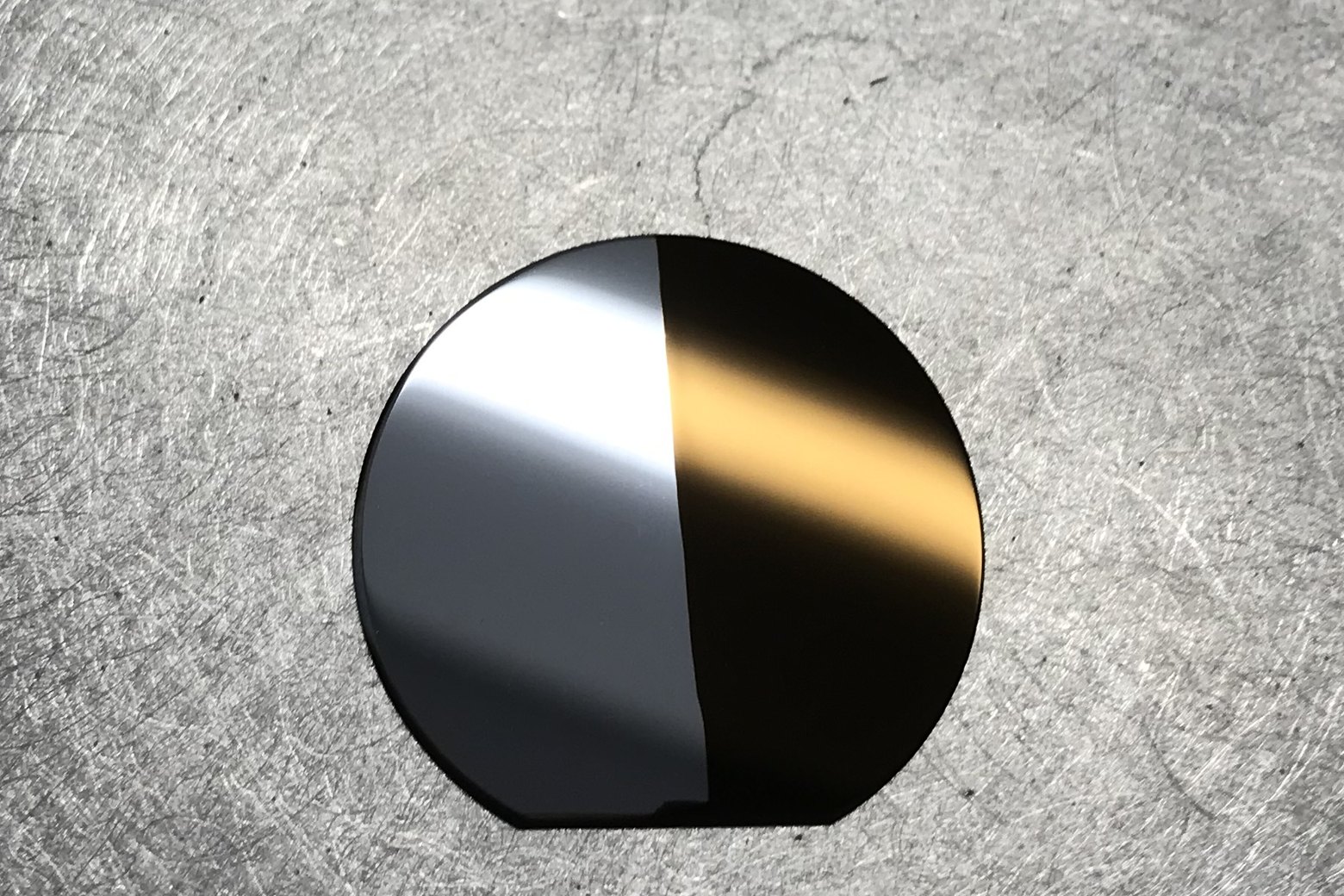
Its defining property is that it is a capacitor. Nothing is exchanged with the liquid, so there are no reaction products, no local change in acidity, and no metal ions released. It is made from inexpensive materials with standard equipment. Many high-density neural recording probes use it for their recording sites.
It has two real limits. Held at positive potentials it slowly oxidizes and loses capacitance, which led at least one major pacemaker maker to prefer iridium-based coatings for that duty. And the deepest parts of its pores cannot be reached during a very short pulse, so the capacitance measured slowly overstates what a fast pulse can use.
Our view: porous titanium nitride is underrated and our bread-and-butter solution in this space. For recording, for counter electrodes, and for any use where the electrode must not change the liquid, it should be the default, and other materials should have to justify themselves against it.
Iridium oxide
Iridium oxide is the performance leader. Sputtered films store 1 to 9 mC/cm² per pulse on small electrodes, an order of magnitude beyond platinum, and they lower recording impedance sharply. Sputtered films have gained ground over the older method of growing the oxide electrochemically on iridium metal. In one direct comparison they tolerated more charge before damage.
It is also the most demanding. The best figures need a positive bias held between pulses, and older activated films lose more than 90% of their capacity without one. Driven beyond its potential limits the film delaminates. Its potential tracks acidity, which makes it a good pH sensor and a poor choice where a steady potential is needed. And iridium is among the most expensive metals in use.
Long-term human data are more encouraging than the failure list suggests. In a study of 980 microelectrodes explanted from three people after roughly three to six years, the iridium oxide tips showed more physical degradation than the platinum ones, yet were twice as likely to still be recording.
Our view: use iridium oxide when a small electrode must deliver high charge and nothing else will do. Do not use it by default.
Ruthenium oxide
Ruthenium oxide works the same way as iridium oxide, and recent reports put its charge capacity and pulsing stability in the same range at a fraction of the metal cost. There is far less evidence for it than for iridium oxide, and ruthenium nitride has been studied even less.
Conducting polymers
PEDOT posts the best numbers of any coating: the lowest impedance and charge figures up to about 15 mC/cm². It also has the weakest record once it leaves the lab. Films peel under long pulsing and under steam sterilization. The most convincing results put the polymer on top of iridium oxide or rough platinum, which then does the work of holding it on.
Our view: a polymer that needs an oxide underneath to stay attached has not replaced the oxide.
Gold and silver/silver chloride
Gold is a conductor and a sensing surface, not a charge-injection coating. It patterns easily and binds the molecules that sensors rely on. Silver/silver chloride holds a steady, well-defined potential, which makes it the usual reference electrode. Pass current through it and it is consumed, quickly at small sizes.
Why the numbers do not compare
Published charge figures for the same material differ by more than tenfold, and the reasons are mundane.
- Stored charge is not usable charge. A slow voltage sweep measures everything a film can store, given time. A pulse lasting a fraction of a millisecond reaches only part of it. The gap is largest for thick porous films.
- Bias changes the answer. Holding an oxide at a positive potential between pulses can multiply what it delivers. Many devices cannot supply that bias.
- Size changes the answer. Small electrodes deliver more charge per unit area than large ones made of the same film.
- Area is ambiguous. Figures are quoted per unit of footprint. A porous film’s true area is far larger and is rarely measured.
One study built identical probes that differed only in coating and measured 0.87 mC/cm² for titanium nitride, where an earlier report had claimed 22. Neither group was careless; they measured different things. The field published a standard test protocol in 2020 for exactly this reason, and a figure quoted without its pulse width, bias and electrode area is hard to interpret.
Sensors are a different problem
Most published work on these films concerns implants. Diagnostic sensors use the same materials under different constraints, and less is written.
A typical electrochemical sensor has three electrodes. The working electrode is where the measured reaction happens, and is usually gold, platinum, palladium or carbon. The reference electrode holds a fixed potential and is usually silver/silver chloride. The counter electrode completes the circuit by carrying whatever current the working electrode needs.
The counter electrode has the least glamorous job and a strict one. It must never be the limiting element, so it needs far more capacity than the working electrode. And it must not release anything that drifts across a very small sample volume and disturbs the measurement.
A porous capacitive film suits this well. A film storing several millifarads per square centimetre can supply a few millicoulombs per square centimetre across a half-volt swing simply by charging its surface, with no reaction at all. For a short measurement drawing microamps, that is ample, and it leaves the sample chemically untouched.
The other difference is economics. An implant electrode is made by the thousand and must last a decade. A sensor electrode is made by the million and must work once, after sitting on a shelf. Cost per part and consistency from lot to lot outrank peak performance.
How to choose
Figure 3 is how we would narrow the field for the three electrodes a device can have. It is a starting point. It leaves out working electrodes for chemical assays, where the assay chemistry decides the material.
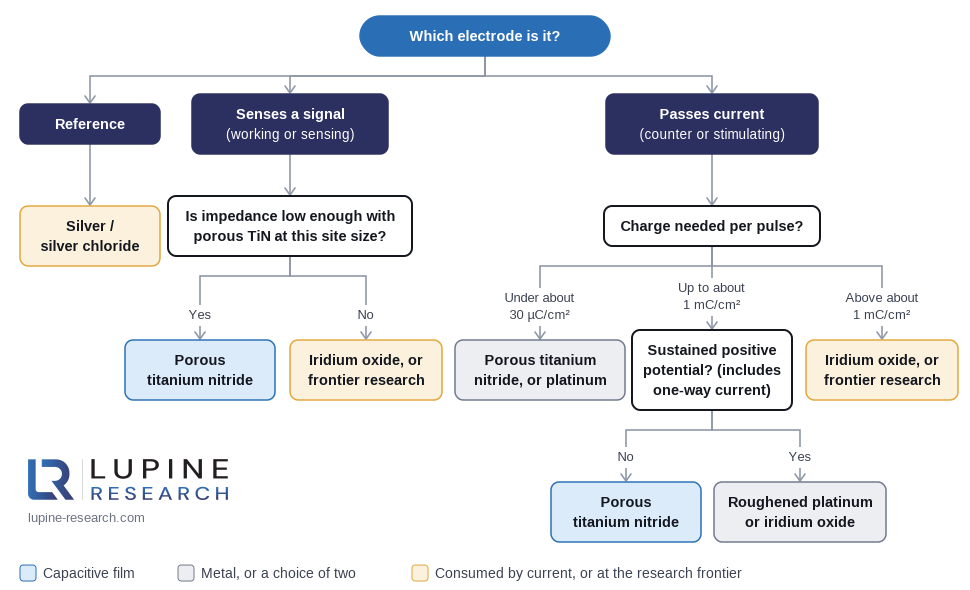
A chart cannot hold everything, so four checks go with it.
- Work out the charge you actually need. Use the real pulse width and the real electrode area, not a figure from a paper.
- Ask whether reaction products matter. If the liquid must not change, as in a small sample volume or beside sensitive chemistry, choose the capacitive film wherever the chart offers one.
- Be honest about lifetime and volume. A ten-year implant and a single-use strip should not get the same coating for the same reasons.
- Compare candidates on your own geometry. Published figures are a guide only.
What we do
Lupine Research sputters porous titanium nitride for electrodes in volume production, and deposits platinum, gold and ruthenium. We characterize films in house with various electrochemical methods, so a trial coating comes back with the measurement that decides whether it works.
Further reading
- S.F. Cogan, “Neural stimulation and recording electrodes,” Annual Review of Biomedical Engineering 10 (2008) 275–309.
- D.R. Merrill, M. Bikson, J.G.R. Jefferys, “Electrical stimulation of excitable tissue: design of efficacious and safe protocols,” Journal of Neuroscience Methods 141 (2005) 171–198.
- J.D. Weiland, D.J. Anderson, M.S. Humayun, “In vitro electrical properties for iridium oxide versus titanium nitride stimulating electrodes,” IEEE Transactions on Biomedical Engineering 49 (2002) 1574–1579.
- S.F. Cogan et al., “Sputtered iridium oxide films for neural stimulation electrodes,” Journal of Biomedical Materials Research Part B 89 (2009) 353–361.
- C. Boehler, S. Carli, L. Fadiga, T. Stieglitz, M. Asplund, “Tutorial: guidelines for standardized performance tests for electrodes intended for neural interfaces and bioelectronics,” Nature Protocols 15 (2020) 3557–3578.