
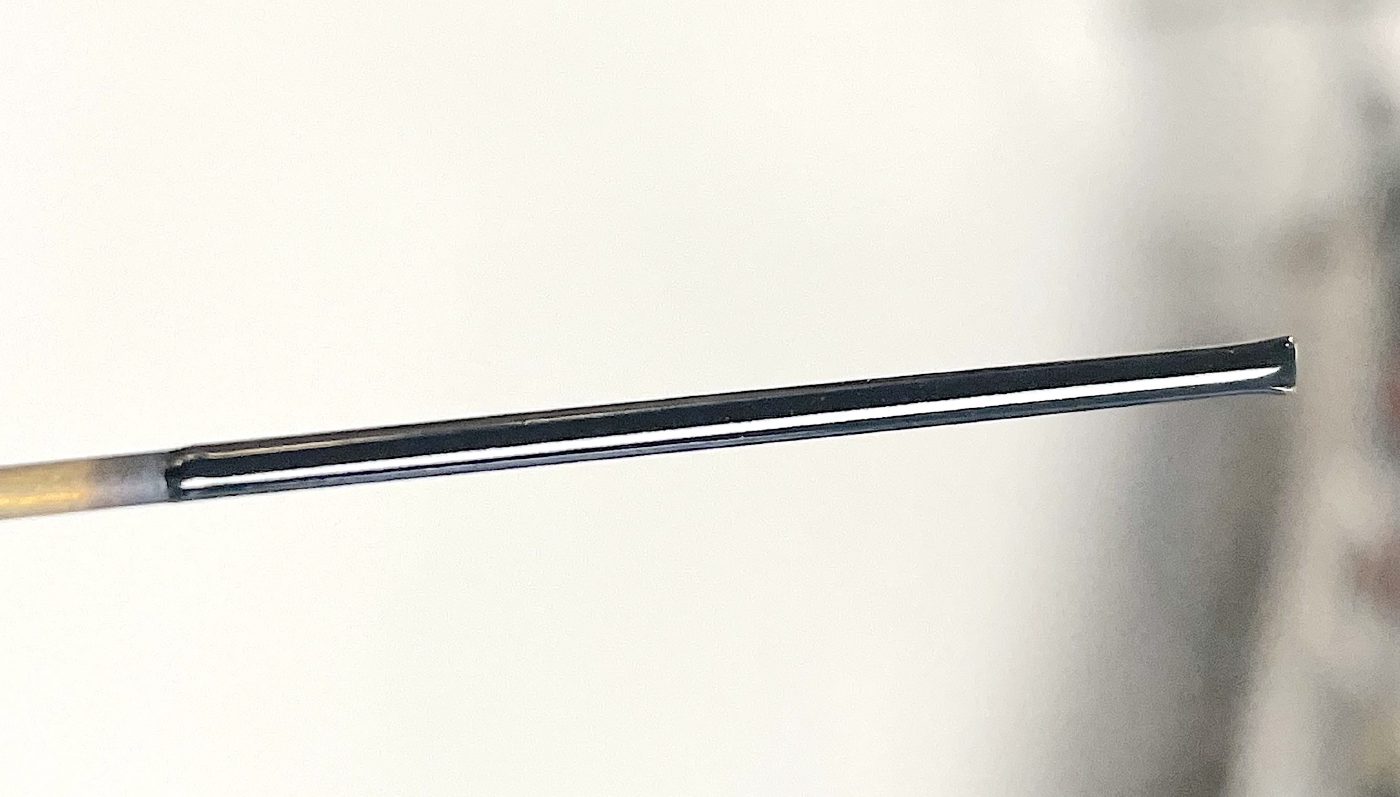
Stainless steel is the workhorse of surgical instruments and demanding industrial hardware — but bare metal conducts electricity, can gall against mating parts, and is vulnerable to aggressive chemistries. Fusing a thin layer of engineered glass directly to the steel transforms the surface: hermetic, glass-smooth, electrically insulating, and inert to nearly everything a device will encounter in service.
Why Engineered Glass?
A modern evolution of vitreous enamel technology, engineered glass coatings begin with glass compositions tailored to the job — dielectric strength, chemical durability, and thermal expansion matched to the substrate. The coating is applied and then fired above the glass transition temperature, fusing it into a fully dense, pinhole-free layer that is chemically bonded to the steel. The result is not a paint or a polymer film: it is a continuous glass surface, permanently married to the metal beneath it.
Benefits
- Hermetic, pinhole-free coverage — a true barrier layer, not a porous coating
- Strong dielectric isolation on an otherwise conductive part
- Biocompatible, chemically inert surface
- Hard, smooth, easy-clean finish that stands up to repeated sterilization
- Fused chemical bond to the substrate — no delamination modes of organic coatings
Materials
Engineered glass coatings are applied to stainless steel alloys, including 301 and 316L. Surface preparation is performed in-house to ensure consistent adhesion and coating quality.
Applications
- Electrical insulation for electrosurgical instruments
- Surgical cutting instruments and reusable device surfaces
- Chemically resistant surfaces for diagnostic and analytical hardware
- Dielectric barriers for industrial electronics
- Corrosion and chemical protection for harsh-environment components